
The next FinTech talent gap: Domain expertise meets AI fluency.
For the past two years, much of the discussion around AI and employment has focused on a fairly simple question: which jobs will AI replace?
From what we are seeing across FinTech recruitment in Europe and Asia, that is increasingly the wrong question. The more immediate change is happening inside existing roles. Companies are reconsidering what a strong product leader, engineering leader, designer, risk specialist or commercial executive should now be capable of delivering when AI becomes part of everyday work.
This is not simply creating more vacancies for AI specialists. It is changing the expectations attached to roles that already exist.
That shift is visible in the data. LinkedIn reports that job postings requiring AI literacy in the US increased by around 70% year on year, while approximately 1.3 million AI-enabled jobs have emerged globally over the past two years. At the same time, European companies appear far more focused on upgrading their existing workforce than building separate AI teams.
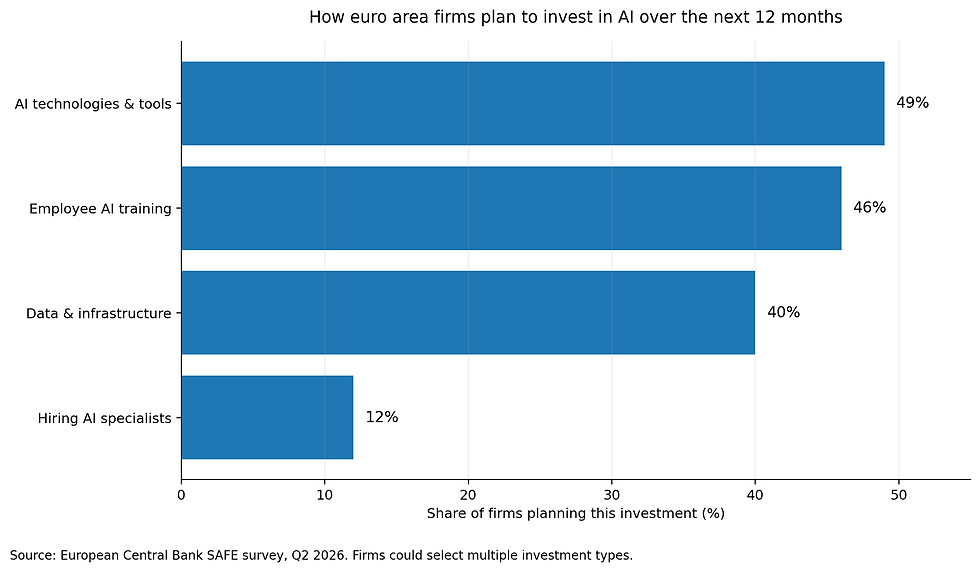
According to the European Central Bank, among euro-area firms planning AI investment over the coming year, 49% expect to invest in AI technologies and tools, 46% in training existing employees and 40% in data and infrastructure. Only 12% expect to invest specifically in hiring AI specialists.
That is an important distinction for hiring managers. AI transformation is increasingly less about adding a separate AI function and more about changing what people across the organisation are expected to do.
AI is changing the definition of a strong hire.
We are already seeing this in senior searches.
In engineering leadership, clients increasingly want to understand how candidates think AI will change software development itself. The discussion goes well beyond whether engineers use Copilot or another coding assistant. Hiring managers are thinking about whether development teams can become more productive, whether release cycles can shorten, how quality assurance may change, and which engineering capabilities will become more valuable as routine development work becomes increasingly assisted by technology.
The more interesting question is what the engineering organisation should look like two or three years from now. A leader who can manage the current team is valuable. A leader who can also anticipate how that team needs to evolve is becoming much more valuable.
We are seeing the same shift in product. Strong product leaders still need to understand customers, regulation, technology, economics and execution. What is changing is the expectation that they can also identify where AI can improve a product, automate a workflow or change the economics of delivery.
Risk and compliance provide another example. The opportunity is not simply to use AI to produce faster reports or summaries. It is to rethink rules, decisioning, monitoring and operational controls so that more of the process can scale without increasing manual workload at the same rate.
That requires people who understand both the technology and the underlying financial-services environment. AI knowledge without domain knowledge is not enough, but increasingly the reverse is also true.
Companies are beginning to question traditional team structures.
One of the most interesting developments we are seeing is not in individual job descriptions but in the assumptions behind team size.
In one recent senior product and design search, the underlying discussion was whether one exceptional senior individual, supported by increasingly powerful technology, could potentially create more impact than a larger traditional team. That is a very different recruitment question.
Historically, many hiring plans started with organisation design. A company decided it needed a certain number of engineers, designers, product managers or analysts and then recruited accordingly. Increasingly, some FinTech companies are starting with the outcome instead. They are asking what the business needs to achieve and what the smallest group of exceptional people capable of delivering it might look like.
AI changes the answer to that question.
This does not necessarily mean companies will simply employ fewer people. It means the value of highly capable people may increase. Someone who combines domain expertise, judgement and the ability to use technology effectively can potentially create significantly more output than somebody operating in the same role in a traditional way.
For recruitment, that raises the bar.
Europe is investing in existing talent.
The European data supports this view. The fact that 46% of euro-area businesses planning AI investment expect to spend on training their existing employees, compared with only 12% expecting to hire AI specialists, suggests that AI literacy is becoming a horizontal capability rather than a narrow specialist skill.
A Head of Product does not need to be an AI engineer, but increasingly they need to understand what AI makes possible. A Chief Revenue Officer does not need to build a model, but they should understand how AI can change market research, account planning, sales preparation and commercial productivity.
The same applies to compliance. A senior compliance leader may never write code, but they should increasingly be able to identify where repetitive controls can be automated, where data can support better monitoring and where human judgement must remain central.
This is why we expect AI literacy to become part of the evaluation criteria for a much broader range of senior appointments.
Hong Kong highlights the talent challenge.
The Hong Kong market provides a particularly interesting example as we prepare for our upcoming visit. AI adoption is already significant across the financial sector. According to figures referenced by the Hong Kong Monetary Authority, AI solutions are being implemented by 83% of large firms, 76% of medium-sized firms and 63% of smaller firms.
At the same time, talent availability is struggling to keep pace. Around 76% of institutions report technical skills gaps relating to GenAI development and use, while 60% report gaps in compliance capability.

Those figures highlight something important. The shortage is not simply a shortage of people who understand AI. The real scarcity is increasingly in combinations of skills.
Financial institutions need people who can understand technology while also understanding regulation, payments, banking, risk, customers and local market dynamics.
That is a much narrower talent pool.
The strongest candidate may not be the person with the deepest technical AI vocabulary. It may be the product leader who understands how AI can improve decisioning while also knowing where regulatory or customer risk requires human judgement. It may be the engineering leader who embraces AI-assisted development but still understands architecture, security and resilience.
The premium increasingly sits at the intersection.
Hong Kong's positioning makes this especially relevant.
This is particularly relevant in Hong Kong because of its role as a bridge between Mainland China, Asia and international financial markets.
For companies expanding internationally, the hiring challenge is already complex. They need people who understand different commercial environments, regulatory systems and cultural expectations. AI adds another layer to that complexity.
A company expanding from Asia into Europe does not simply need an experienced executive. It increasingly needs someone who can operate across markets while also understanding how technology is changing the function they lead.
The same applies in the opposite direction for European companies building in Asia.
That is one reason we believe international FinTech hiring will become more specialised rather than less specialised as AI develops.
Singapore is treating AI as a workforce issue.
Singapore offers another clear indication of where this is heading. In September, 23 financial institutions committed to training more than 80,000 employees in critical AI skills by 2028 through the AI Workforce Co-Lab. More than half of those employees had already received training at the time of the announcement.
That is significant because it is not an AI recruitment programme. It is workforce transformation at scale.
The initiative includes leaders, operations professionals and wealth-management employees, which reinforces the idea that AI capability is moving beyond technical departments.
Singapore is also backing this transition with substantial investment. The Monetary Authority of Singapore has committed S$220 million over three years to the next phase of FinTech innovation, including AI adoption, infrastructure and talent development.
The wider ecosystem now includes more than 1,800 FinTech firms and close to 10,000 professionals.
When we are in Singapore later this year, this is one of the topics we will be particularly interested in discussing with FinTech companies, financial institutions and investors. The challenge is increasingly not whether organisations should adopt AI, but how they redesign work around it.
CVs are becoming a weaker indicator of readiness.
There is also a practical recruitment problem. AI fluency is surprisingly difficult to judge from a CV. Almost anybody can now add terms such as Generative AI, ChatGPT, Copilot or AI strategy to their profile. Those words tell us very little about whether technology has genuinely changed the way that person operates.
In senior interviews, the more useful discussion is about behaviour and outcomes. We want to understand what candidates are doing differently today because AI exists, which parts of their function have become faster or more effective, and where they believe human judgement remains essential.
It is also increasingly revealing to ask whether they would build their current team in the same way if they were starting again today. The answers to those questions tell you much more than a list of tools. They show whether someone is simply experimenting with AI or has begun to understand its organisational implications.
Domain expertise becomes more valuable, not less.
There is a risk that companies overcorrect. As AI becomes a board-level priority, hiring teams can start favouring candidates who speak most confidently about technology. In financial services, that can be dangerous. Payments infrastructure, licensing, AML, fraud, credit, acquiring, settlement, data protection and regulatory accountability do not disappear because AI improves productivity.
In many cases, AI actually increases the value of experienced judgement because decisions can now be made and implemented faster. A product leader still needs to understand why a payment fails. A compliance leader still needs to understand why a control exists. An engineering leader still needs to understand architecture and security. A commercial leader still needs to understand why a bank, merchant or platform actually buys. AI can amplify good judgement, but it does not replace it.
The next talent shortage will be about combinations.
For years, FinTech recruitment has been defined by specialist shortages. Experienced payments leaders remain difficult to find. Strong product builders remain scarce. Compliance professionals with regulator credibility are in demand. Engineering leaders who understand financial infrastructure continue to command a premium. AI adds another layer to those existing shortages.
The strongest candidates increasingly combine deep functional expertise, sector knowledge, commercial judgement, adaptability and practical technology fluency.
That combination is rare. And we expect it to become increasingly valuable.
For hiring managers, this means the brief itself may need to change before the sourcing begins. The key question is no longer simply whether a candidate has done the role before. It is whether they are capable of leading that function as the role evolves. A person who perfectly matches today's organisation may not necessarily be the person best equipped for the organisation three years from now.
What we will be watching in Hong Kong and Singapore.
As we prepare for our upcoming time in Hong Kong and Singapore, this is one of the themes we are particularly interested in exploring with founders, executives, financial institutions and investors. Europe, Hong Kong and Singapore are approaching AI from different regulatory, economic and cultural starting points, but the talent challenge is beginning to converge. How do companies combine deep financial-services expertise with the ability to operate effectively in an AI-enabled organisation? That question will influence how teams are built, which skills command a premium and how senior talent is assessed.
The next FinTech talent gap may therefore not be a shortage of AI professionals. It may be a shortage of experienced FinTech professionals who know what to do with AI.
And those are not the same thing.

Comments